20–27 March 2026 • Hong Kong

b
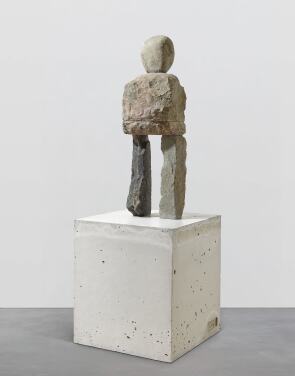
eyond the abstract brings together a diverse group of modern and contemporary works by artists including Mark Rothko, Cy Twombly, Sanyu, Joan Mitchell, and Zao Wou-Ki, to explore how abstraction can evoke the unseen forces that animate the world. Through shifting planes of colour, calligraphic gestures and delicately balanced forms, painting, sculpture and works on paper unfold alongside historic objects and artefacts, creating a dialogue between artistic traditions across cultures and centuries. From African and ancient sculptures transformed by iconoclasm and erosion over time, to literati objects and manuscripts, these forms reveal how abstraction has long emerged through both intention and chance. Drawing on philosophical ideas that span cultures—including Zen, Taoist and other metaphysical traditions—the exhibition considers abstraction as a language capable of expressing energies beyond the visible. In works that hover between stillness and movement, solidity and void, presence and absence, the viewer is invited into a meditative space where colour, rhythm and form become conduits for reflection on the ephemeral and the ineffable.
20-27 March 2026
Monday–Saturday | 11:00AM–7:00PM
Sunday & Public Holiday | 11:00AM–6:00PM
Sotheby's Maison, Hong Kong
Landmark Chater, 8 Connaught Road Central, Central


“The forms disappeared and were no more than a dream. A sketch that slowly falls upon the forgotten canvas, that the artist completes from memory alone.”

The shifting planes of colour, conceived as synesthetic evocations of energies and emotions, seen in Mark Rothko’s No.10 appear less as a painted surface than an incorporeal space beyond form, an atmosphere in which the viewer is invited to dwell. Suspended in quiet expansiveness, Rothko’s vast field of colour suggests in its material and psychological depth something beyond itself, not simply a series of forms, but a balance of opposing and obscure forces. Engendering a sense of imminent but hidden feelings of stillness, and of limitless action, Rothko’s canvases evoke the contemplative experience found in the tradition of Chinese scholar’s rocks. The literati, particularly during the Song dynasty, valued these rocks as microcosms of the hidden energies which shape the universe, their voids and perforations being not simply empty spaces, but conduits through which qi circulated, suggestive of the constant interplay between solidity and absence. These are the invisible forces which similarly animate Alexander Calder’s delicately balanced mobiles, where sound, form, colour and motion are suspended, poised to allow movement to become part of their unfolding presence. Radiant, sublime and provocative of visual and somatic experiences which transcend spatial and temporal boundaries, such works by Calder and Rothko, alongside pieces by Joan Mitchell, Sanyu and Bridget Riley, pursue a language of colour and space which gesture towards the numinous. Transforming the painted surface into a site of energetic and spiritual resonance, where presence and negation exist in delicate equilibrium, these works are a meditation on the unity of matter and spirit, lingering in the space between material presence, and the ineffable space beyond.


“It would be good if little places could be set up all over the country, like a little chapel where the traveller, or wanderer could come for an hour to meditate on a single painting hung in a small room, and by itself.”

The qualities of concealment, crepuscularity, tranquility, mystery and depth found in scholar’s rocks and calligraphic brushwork hold a psychic charge which open up possibilities for the mind to wander. The tradition of metaphysical speculation, particularly that of Zen Buddhism, but also other Asian religions including Hinduism and Taoism, provided artists, particularly in the Western tradition during the 20th century, with a conceptual basis for the understanding and representation of the spiritual and universal potential of abstract art. The calligraphic brushstroke became one of the most compelling vehicles for this sensibility. Charged with the possibility of unfolding action, these gestures give form to the invisible forces which animate their material presence.

From the looping, calligraphic traces which hoover across the surface of Cy Twombly’s Untitled (New York City), where thought and movement seem to unfold like fleeting psychic energies, to the sweeping gestures of Joan Mitchell’s La Grande Vallée VII Diptych, the brushstroke is transformed into a performance of sensation and expression. As with the eruptive gestures of Zao Wou-ki’s Nuage, the depths of which appear to possess an inner cosmology, abstraction becomes the conduit for the circulation of energy between matter, form and spirit. As William C. Seitz has described in reference to calligraphy, which he saw as representing “nothing beyond itself,” the brushstroke – its movement, undisclosed but felt – embodied “a symbolic reference which involves not only its shape, but the spirit – lyrical, violent, or tentative – in which it was executed” (William C. Seitz, “Abstract-Expressionism Painting in America: An Interpretation Based on the World and Thought of Six Key Figures”, Ph.D diss., Princeton University, 1955, pp. 34-35).


beyond the abstract traces the philosophical and aesthetic currents that shaped these inquiries, from abstract art and calligraphy to fragmentary sculpture and Minimalism, positioning abstraction as a sublime reflection on the ephemeral experience of life. By stripping away narrative, symbolism, or illusionism, these artists cultivate states which are sublime, moving beyond form and perception, toward the contemplative and metaphysical. Encouraging us to encounter these works beyond expectation or habit, beyond the abstract presents meaning not from presence, but from the charged liminal space between things. Through shifting planes, veiled gestures and repetitions that verge on disappearance, the viewer is invited to dwell at the edge of perception and possibility.